Qualifications
The course you’d have wanted at the end of a double shift.
Ten CPD-standard food hygiene and workplace certificates, written by people who have worked the line, on a learning system we built ourselves so it works the way a kitchen does.
Three questions from Level 2. Answer them here.
This is the real thing: one question at a time, and you find out straight away whether you were right and why. Every course works like this.
Drawn from the Level 2 Food Safety & Hygiene bank. Nothing is recorded.
Which bacterium is the most common cause of bacterial food poisoning in the UK?
What a learner actually goes through.
Five moments, the same in every course, in this order. The screens are the real player.
-
Lesson
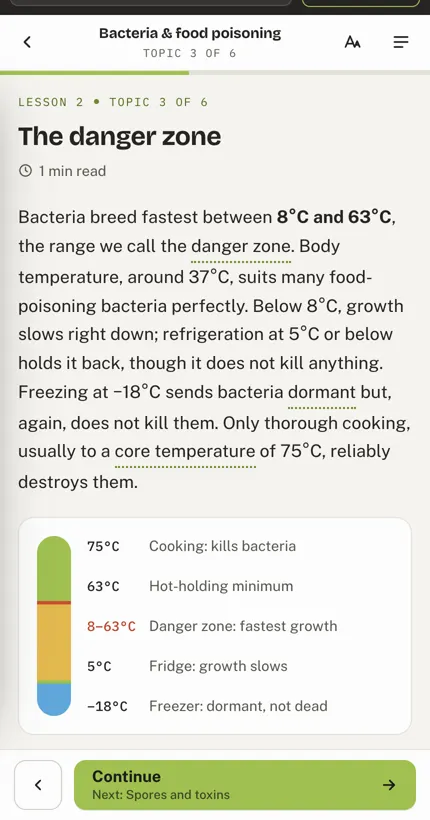
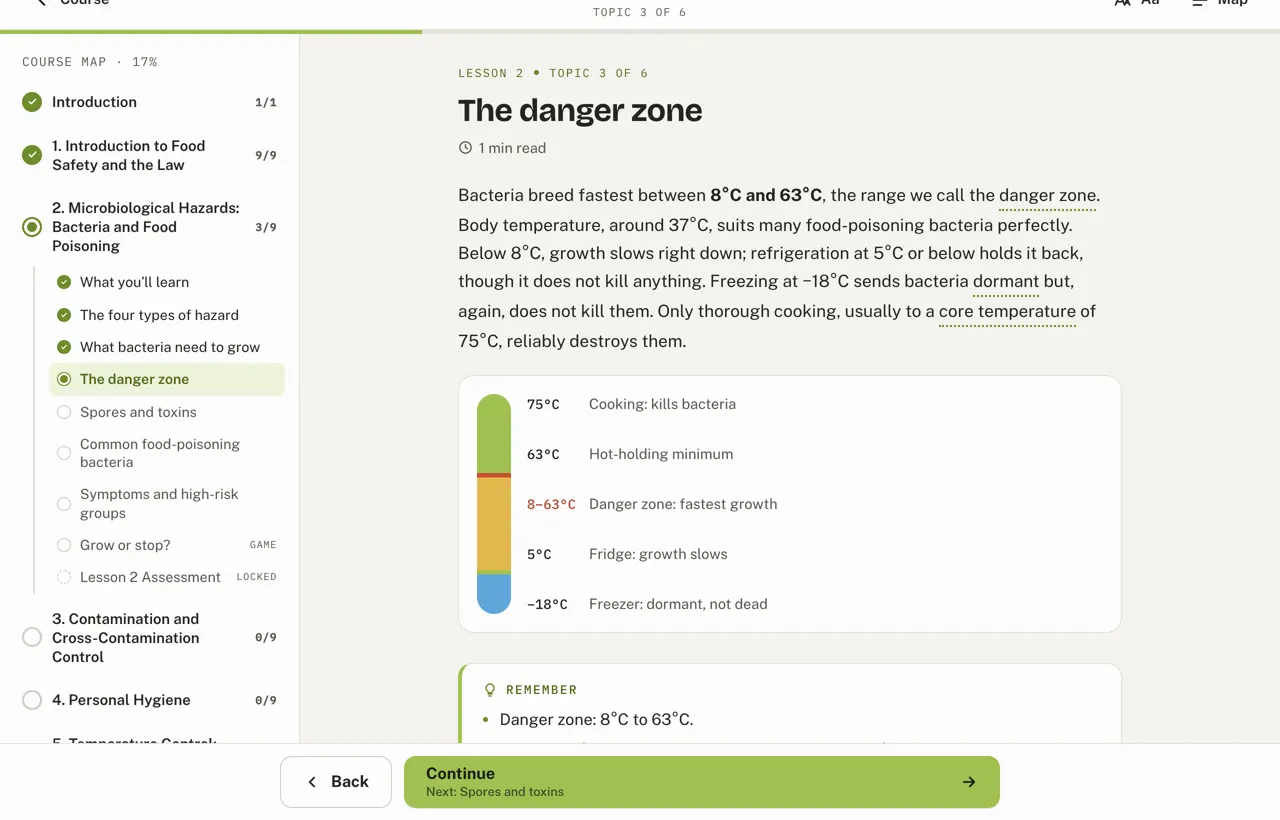
One thing at a time, with a photograph of the real thing.
Six short topics a cook reads between shifts. In fourteen languages.
-
Practice
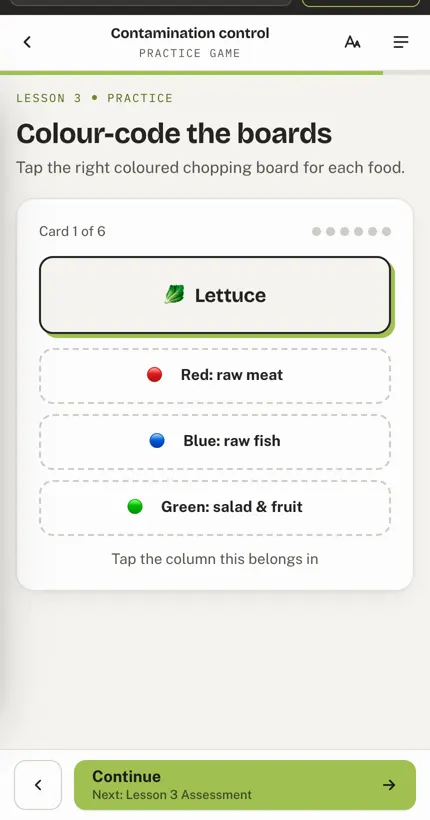
A game before the questions.
Colour-code the boards, sort the fridge, order the handwash. You cannot continue until you have done it.
-
Check
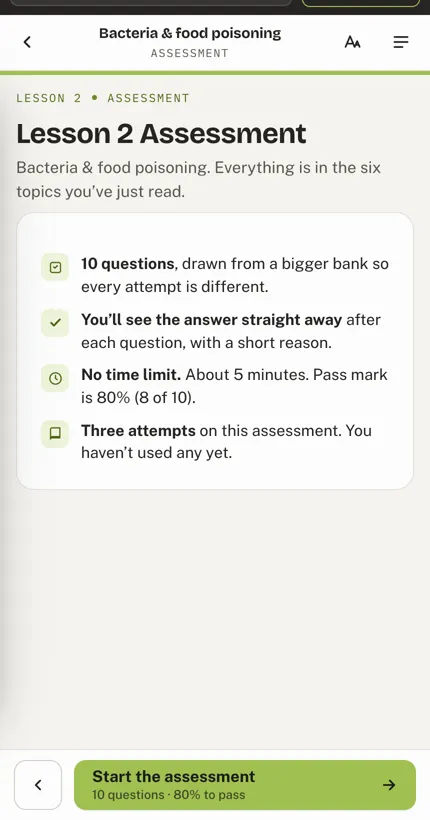
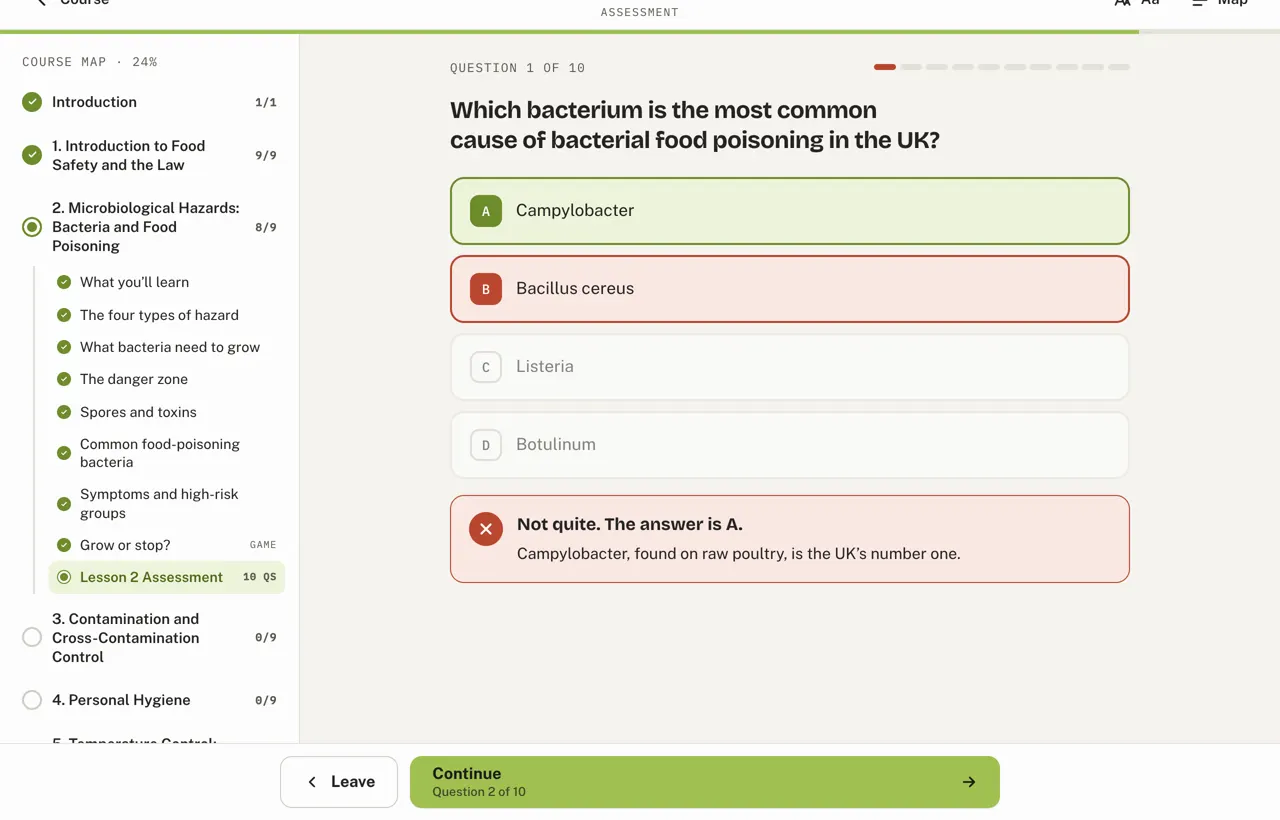
You find out straight away, and why.
Ten questions drawn from twenty, one at a time. A wrong answer shows the right one and the reason.
-
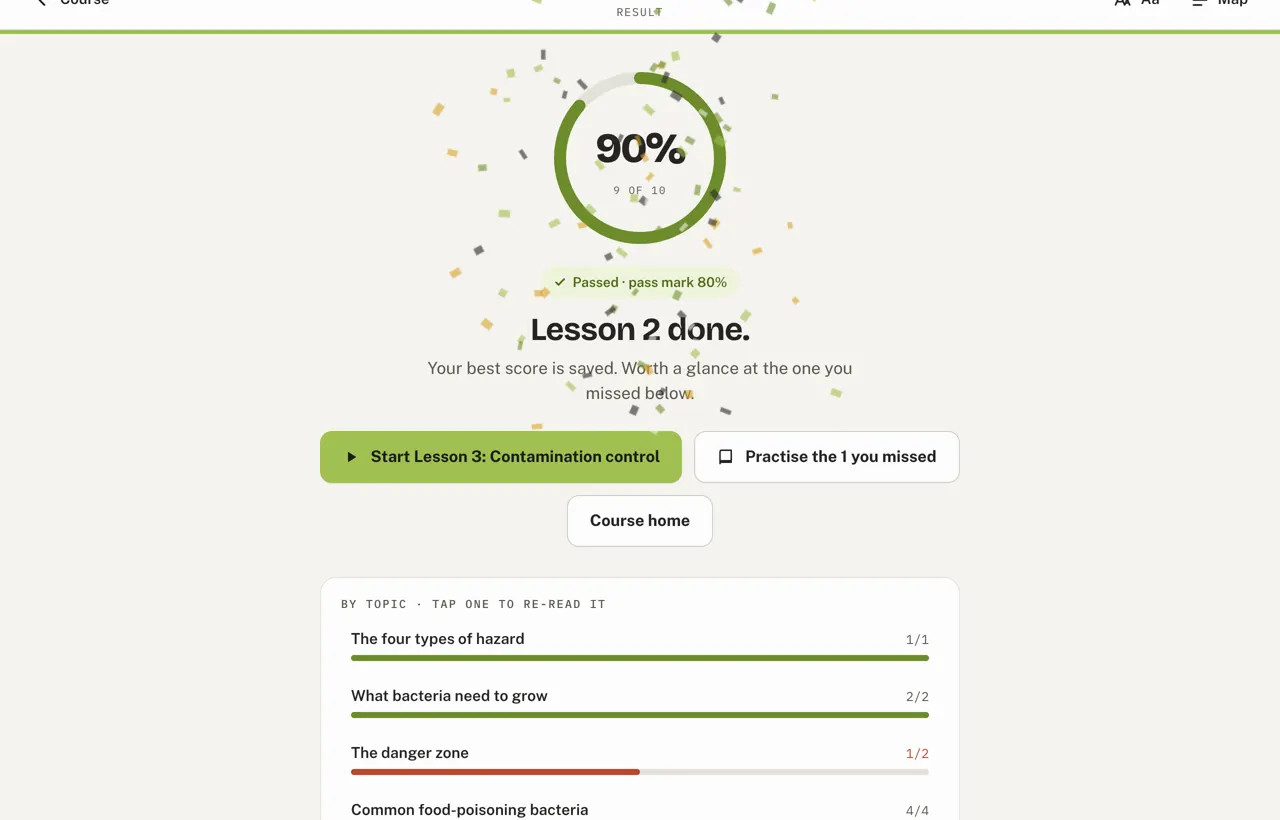
Result
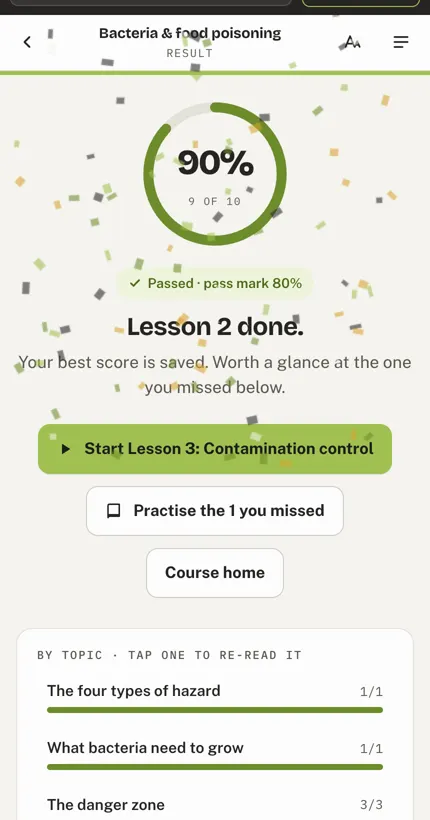
Eighty percent to pass. Three attempts.
Fail, and it tells you which topic to re-read. Pass, and the next lesson unlocks.
-
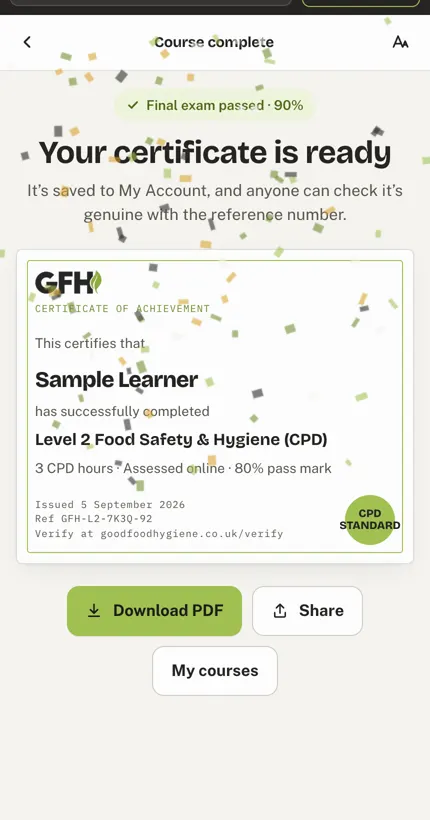
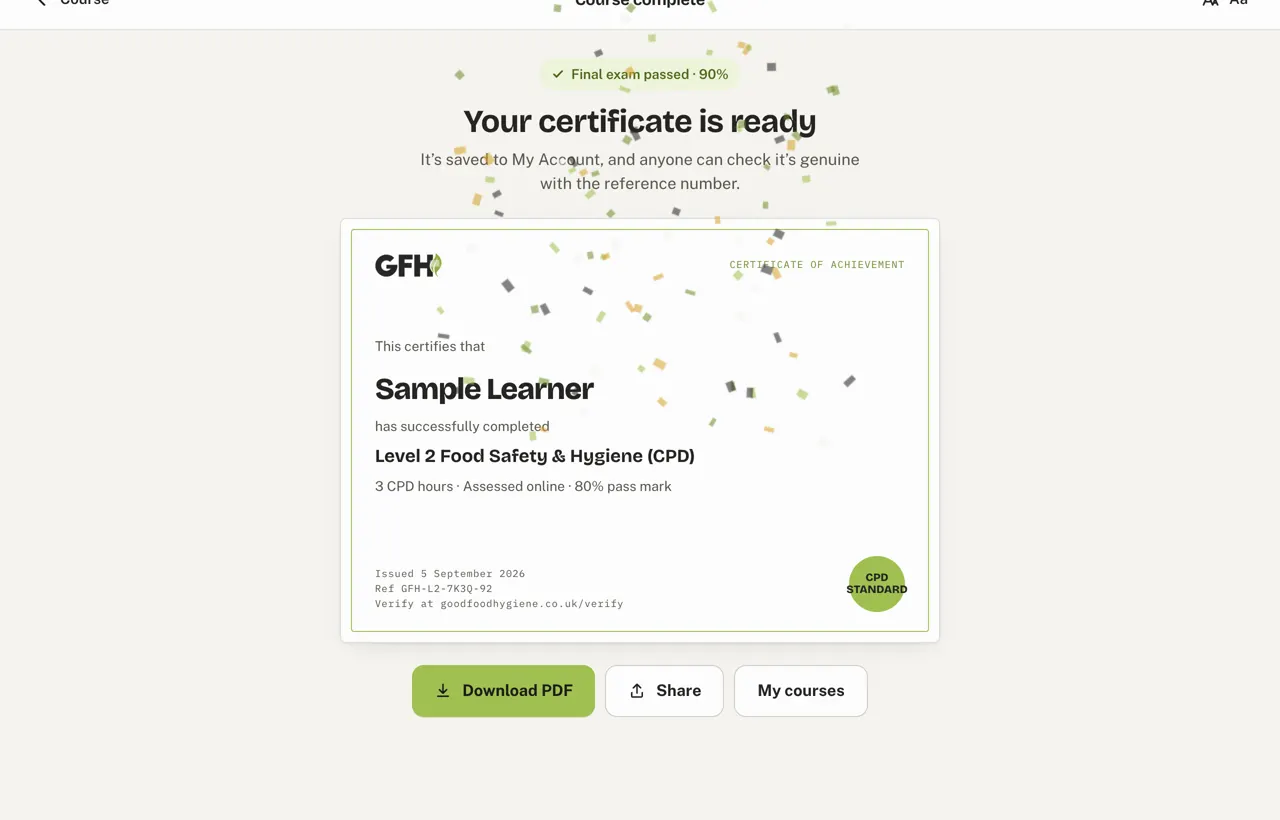
Certificate
Issued the moment you pass the final.
Saved to your account, emailed to you, and checkable by anyone with the reference or the QR code.
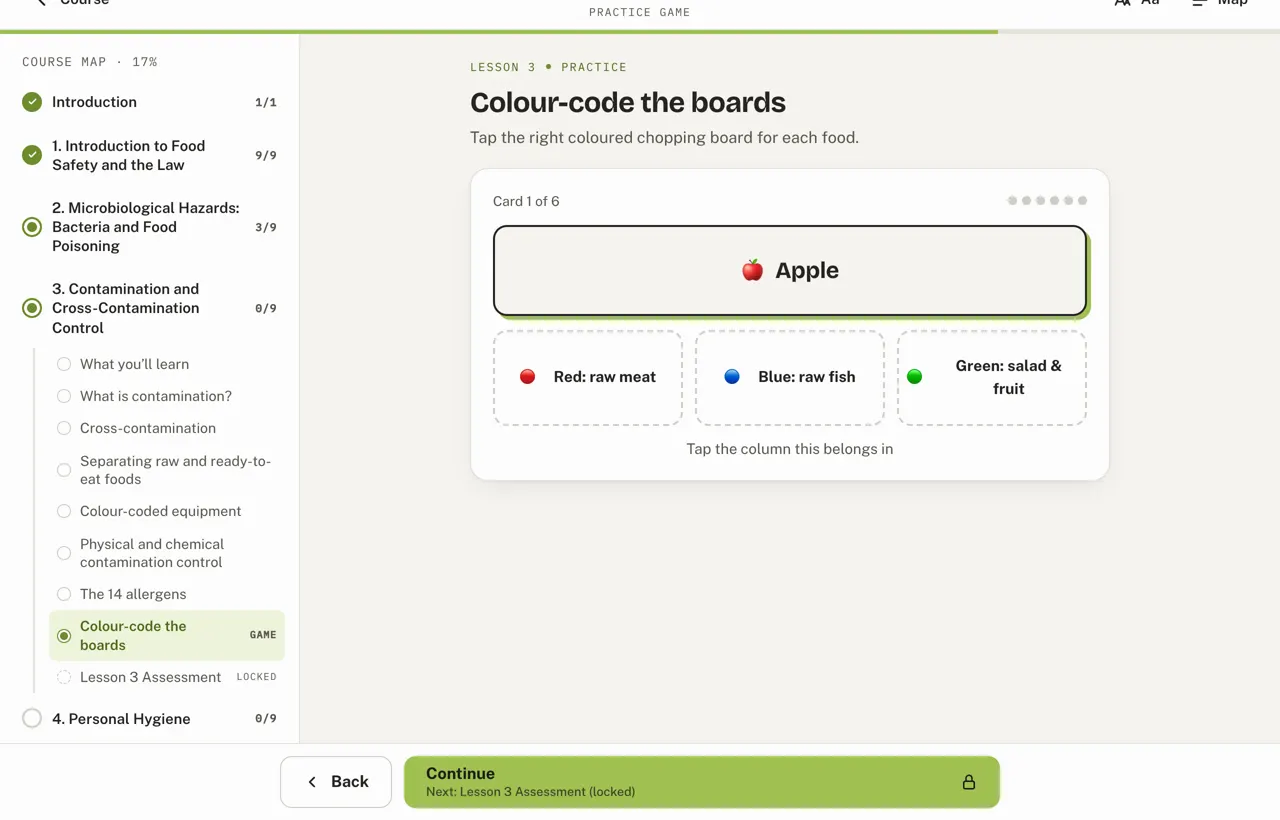
Colour-code the boards.
The practice game from Lesson 3 of Level 2, as it is in the course. Tap a food, then the board it belongs on. You get it wrong, it tells you why.
Every lesson that is about doing ends with one of these. Ours, built once, used in every course.
Tap the board this belongs on
Every certificate a kitchen needs. One standard.
Level 1 to Level 3 food hygiene and the workplace courses that sit beside them. Every one has a free taster. Who is it for?
- Level 2 Food Safety & Hygiene Anyone who handles, prepares, cooks, serves or transports food
- Level 3 Food Safety & Hygiene for Supervisors Managers, supervisors and anyone responsible for a food safety system
- Level 2 HACCP for Catering & Retail Anyone who writes, runs or checks a food safety management system
- Level 2 Food Allergy Awareness Kitchen and front-of-house staff who take orders or prepare food
- Level 1 Food Safety & Hygiene Awareness New starters and anyone working around food
- Level 2 Health & Safety in the Workplace Every employee, with hospitality examples throughout
- Level 1 First Aid Anyone who may be first on the scene
- Level 1 Manual Handling Deliveries, cellars, kitchens and stores
- Level 1 COSHH Anyone using cleaning chemicals and sanitisers
- All levels Equality, Diversity & Inclusion Every member of staff; managers especially
Checkable by anyone, in seconds.
A reference, a QR code and a public verify page. This is what an inspector sees when they scan it.
reserved for the CPD logo
Certificate of achievement
This is to certify that
Sample Learner
has successfully completed and been assessed in
Level 2 Food Safety & Hygiene
- Name
- Sample Learner
- Course
- Level 2 Food Safety & Hygiene
- Completed
- 19 July 2026 · 92%
- Refresher
- 19 July 2029
- Issued by
- Good Food Hygiene
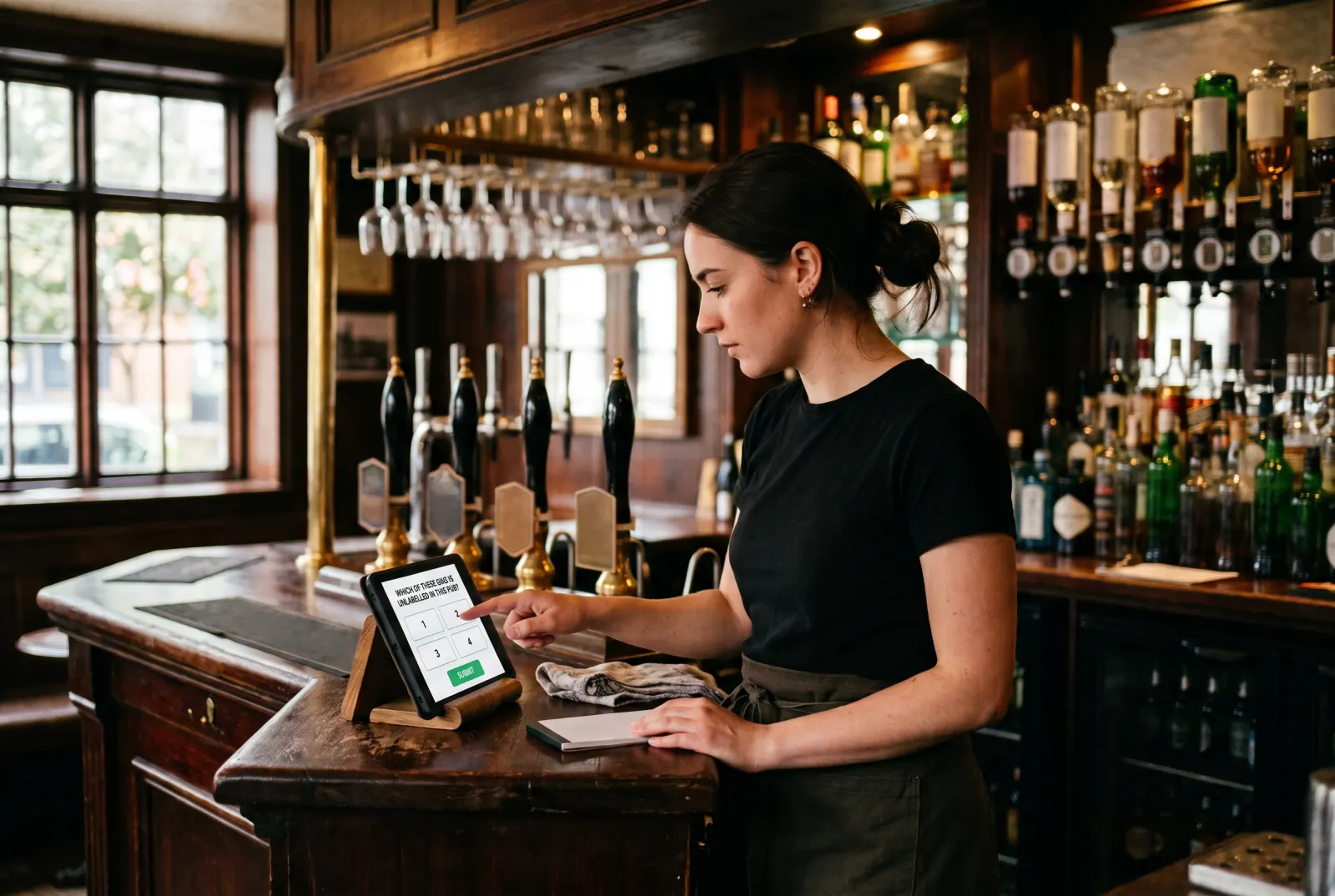
We have sat the boring hour on a laptop. Many times.
Thirty years in kitchens and bars is thirty years of mandatory training: the same course every three years, and a new starter to put through their first one every other week. We have done them as the pot washer, as the chef, as the manager, and as the person signing off someone else’s.
So the courses are written by us, in the language a kitchen uses. And the system they run on is ours too: the lessons, the games, the questions, the certificates, the team accounts, built from scratch so it works the way a kitchen needs it to, not the way a generic training platform happens to.
- Not a slideshow. Short topics with a photograph of the real thing, in fourteen languages we wrote, not machine-translated.
- Not a quiz you guess through. Questions drawn at random, one at a time, the reason shown every time, graded on the server.
- Not a PDF in an inbox. A certificate anyone can verify, a team dashboard that shows who has lapsed.
Administered like a record, because that is what a certificate is.
A certificate is a claim about a person that an inspector may test. Everything around it is built to be checked.
A reference and a QR code on every certificate open a public verify page. An employer or an EHO sees the issuing record in seconds.
A business buys seats and assigns them. Each member of staff gets their own login and a certificate in their own name, and the manager sees who has finished.
Three years is the industry norm. The account holder is reminded before it runs out, not after.
Standards and policies
The questions buyers ask.
Plain answers. If yours is not here, the contact page lands with a person.
Is a Level 2 certificate a legal requirement?
The law says food handlers must be trained, instructed or supervised to a level that matches their job. A Level 2 certificate is the usual way a kitchen shows an officer that has happened. Level 1 suits new starters and non-handlers; Level 3 is for the person running the system.
Will an Environmental Health Officer accept it?
Officers check that training is adequate and evidenced. Our courses follow Food Standards Agency guidance and UK food law, are written to CPD standard, and every certificate can be verified online. We are being prepared for CPD assessment and do not describe the courses as accredited until that concludes.
How long is it valid?
A certificate does not expire, but a refresher every three years is the industry norm and what most officers expect. We remind you before then.
What if I fail an assessment?
You get three attempts at each, and the result tells you which topic to read again. Nobody sits the final exam until every lesson check is passed.
Can my team learn in their own language?
Yes. Every course is written in fourteen languages, not machine translated. The certificate is issued in English, because the person checking it reads English.
Can I try before I buy?
Every paid course has a free taster: four lessons and a fifteen-question quiz, no card needed.